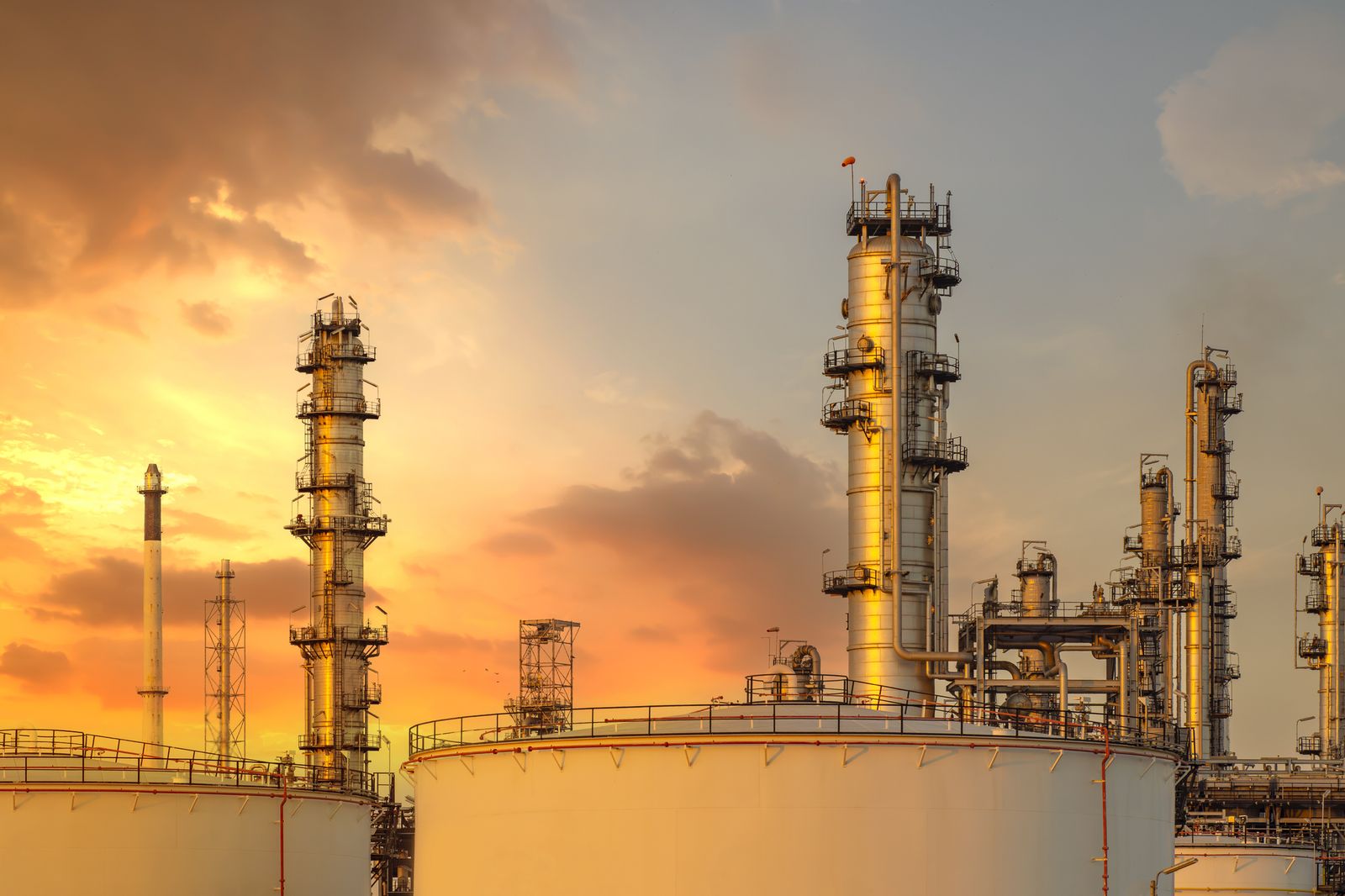
An oil refinery is an industrial plant that turns crude oil into fuels and other products people can actually use: petrol, diesel, jet fuel, kerosene, cooking gas (LPG) and feedstock for plastics. In Nigeria in late 2026, the story of refining is mostly one plant. The privately owned Dangote refinery in Lekki ran at 700,000 barrels per day (bpd) in a mid-2026 performance test. The federal government said in September 2026 that NNPC's Port Harcourt, Warri and Kaduna refineries were not producing. Smaller modular refineries fill niche regional demand.
What does an oil refinery do?
Crude oil straight from the ground is a mix of thousands of hydrocarbons. On its own it is not much use to a car, generator or aircraft. A refinery splits it up and upgrades the pieces. The process runs in broad stages:
- Distillation: crude is heated and fed into a tall column. Lighter components such as gas and naphtha rise to the top, while heavier ones such as diesel and fuel oil condense lower down.
- Conversion: units such as crackers and reformers break heavy molecules into lighter, more valuable ones, or reshape them to raise petrol quality.
- Treating: sulphur and other impurities are removed so the fuels meet specifications.
- Blending and storage: streams are mixed into finished grades and sent out by pipeline, ship or truck.
Capacity is quoted in barrels of crude processed per day (bpd). A refinery that is "complex", with more conversion units, can squeeze more petrol and diesel out of each barrel than a simple one.
Why refineries matter so much in Nigeria
Nigeria is one of Africa's largest crude producers. For decades, though, it exported crude and imported most of its petrol, because its own refineries ran far below capacity. That gap tied fuel prices and foreign-exchange demand to imports. It also tied them to the subsidy debate. For readers in the diaspora, this is why refinery news moves pump prices, the naira and household budgets at home. You can follow the currency side on the Jump.AFRICA FX rates page.
Dangote refinery: capacity and status in 2026
The Dangote refinery sits on a 2,635-hectare site in the Lekki Free Zone outside Lagos (see our guide to Lekki). It began producing fuel in 2024. Its nameplate capacity is 650,000 bpd. In June 2026, BusinessDay reported that it had processed 700,000 bpd in a performance test run by independent process licensors, 50,000 bpd above nameplate.
Dangote Industries has also announced an expansion to 1.4 million bpd within about 30 months, with 2028 as the target. At that size it would compete for the title of the world's biggest refinery. The company has not published the cost of the expansion. Besides petrol, diesel and aviation fuel, the group plans to supply LPG, polypropylene and linear alkylbenzene, an input for detergents.
NNPC's Port Harcourt, Warri and Kaduna refineries
NNPC Limited owns four older refineries. Premium Times put their nameplate capacities as follows:
| Refinery | Location | Nameplate capacity |
|---|---|---|
| Port Harcourt Refining Company (two plants) | Rivers State | 210,000 bpd combined |
| Warri Refining and Petrochemical Company | Delta State | 125,000 bpd |
| Kaduna Refining and Petrochemical Company | Kaduna State | 110,000 bpd |
| Total | 445,000 bpd |
The plants have had repeated rehabilitation projects. Premium Times reported that Warri reopened in December 2024 but was shut soon after over safety concerns, and that Port Harcourt went offline ahead of scheduled maintenance. In October 2025, NNPC said it was reviewing the plants technically and commercially and would look for experienced technical equity partners to upgrade or repurpose them. In September 2026, Minister of State for Petroleum Resources Heineken Lokpobiri said none of the three sites was producing. He cited a briefing from NNPC Group CEO Bayo Ojulari and said new partnerships with Chinese companies were being negotiated.
Reports differ on how much has been spent on rehabilitation. In the same interview, figures of about $1.4 billion and $1.5 billion were cited, and other outlets quote different totals depending on which plants and years they count. Treat any single number with caution until NNPC publishes audited figures.
Modular refineries
Modular refineries are small, prefabricated plants that can be built faster and closer to oil fields. They usually focus on diesel, kerosene, naphtha and fuel oil rather than a full product slate. The best-known example is Waltersmith in Ohaji-Egbema, Imo State. It was commissioned in 2020 and has recently doubled its capacity from 5,000 to 10,000 bpd. The company says it has supplied more than 1.1 billion litres of products, mainly to the South-East and South-South, and is planning a 30,000 bpd condensate refinery. Modular plants matter for local supply and jobs, but their combined output is small next to Dangote's.
What to watch next
- Whether Dangote keeps running above nameplate and sticks to the 1.4 million bpd timeline.
- Whether NNPC signs binding partnership deals for Port Harcourt, Warri and Kaduna, and on what terms.
- Crude supply arrangements for local refiners, which affect how much Nigerian crude stays at home.
- Pump prices and the naira, which respond to all of the above.
For wider context on how the oil economy shaped the country, read our history of Nigeria. Investors can also meet energy professionals through the Jump.AFRICA network.
Sources
- Dangote refinery hits 700,000 bpd, eyes world's biggest refinery title by 2028 (BusinessDay)
- NNPC Limited seeks partnership to revamp struggling refineries (Premium Times)
- Nigerian government admits three refineries not working (Sahara Reporters)
- Waltersmith supplies 1.1bn litres of refined products in 6 years (AllAfrica)